
You CAN get a mortgage in Italy as a foreigner. Even if you live abroad. Even if you earn your income in dollars.
BUT — and this is a big but — the rules are completely different from what you’re used to in the US or UK or your home country. And if you walk into this without knowing what you’re doing, you’ll either get rejected or overpay.
I’m Jacopo Tartaglia, founder of Valente Italian Properties. On this channel, I explain the Italian real estate market in plain English. My job is to help international buyers and investors buy and manage their properties in italy.
We have clients from us, uk, canada, israel, Romania, Iraq, South america, emirates and many other countries. So we probably have managed your situotion before.
In this guide, we’re tackling Italian mortgages for foreign buyers. I’ll be also sharing something we haven’t said publicly before: the 2 specific banks that work with international clients. That alone could change your buying strategy completely.
Can Foreigners Actually Get a Mortgage in Italy?
Yes. Period.
But let me tell you something that surprises almost everyone I talk to. Italian banks don’t care where you live. They care where your income comes from.
Think about that for a second. An Italian citizen who moved to London five years ago and earns a salary in pounds? For an Italian bank, that person is treated almost exactly like a foreign buyer. They’re considered a “non-resident with foreign income.”
On the flip side: an American who relocated to Milan, got a job at an Italian company, and pays taxes in Italy? That person can potentially access the exact same mortgage conditions as a local Italian buyer. Including up to 80% loan-to-value. Maybe even 100% if they’re under 36.
So the key variable isn’t your passport. It’s where you earn and pay taxes.
| 📋 KEY RULE | For most foreign buyers — vacation home, retirement, investment — standard maximum loan is 50–60% of appraised value. In specific cases (covered below), this can reach 70%. |
Let me put that in real numbers. If you’re buying an apartment in Florence for €300,000, the bank will lend you at most €150,000 to €180,000. You need to cover the rest yourself — plus taxes and fees, which add roughly 10% on top.
So for that €300,000 property, your total out-of-pocket could be €150,000 to €180,000. That’s a big number. And it’s why pre-approval matters so much before you start property hunting.
but..
How Italian Banks Evaluate You?
The key metric is the debt-to-income ratio. In Italy, your monthly mortgage payment cannot exceed 30 to 35% of your monthly net income. After taxes.

Let’s say you earn £60,000 per year before tax. After UK tax, that’s roughly £43,000 net, or about €5,000 per month. Applying the 35% rule, the maximum monthly mortgage payment the bank will allow is about €1,750. At current Italian mortgage rates — let’s say 3.8% fixed over 20 years — that payment supports a loan of roughly €260,000.
Now — what counts as income? This is where it gets interesting.
| Income Type | Bank Reception | Notes |
| Employed salary (employee) | ✅ Easy | Salary slips + 2 years of tax returns |
| Self-employed / freelancer | ⚠️ Trickier | 2–3 years consistent income required |
| Pension / retirement income | ✅ Good | Guaranteed income — often favorable. But attention to the duration of the loan (more on this later) |
| Dividends / investment returns | ❌ Hard | Often discounted or excluded entirely |
| Rental income | ❌ Hard | Banks heavily discount — may not count |
Source: Standard Italian bank practice, 2024–2025. Individual bank policies vary.
But the bank will also check if you have a good credit report.
Credit report for a mortgage in Italy
The bank will also check whether you have other long-term loans or fixed financial commitments in your credit report. This includes:
- Existing mortgages
- Rent payments
- Other recurring expenses
All these commitments affect your ability to repay debt in the eyes of the bank and therefore reduce your sustainable monthly payment.
So, in the previous example, if you could afford a monthly payment of €1,750, but you already have, for instance, a €1,000 mortgage in the United States, your sustainable payment in Italy is no longer €1,750 — it drops to €750.
If you’re an American buyer, the bank may ask for a credit report from Experian. Yes. An Italian bank asking for a US document. They have no way to check your Italian credit history if you’ve never had an Italian loan. Get your Experian report early.
But you also have to take in consideration the LOAN TO VALUE (LTV).
The Loan-to-Value Limits — And How to Push Them
Loan-to-Value (LTV) is the percentage of the property’s value that the bank is willing to finance through a mortgage.
| Buyer Profile | Max LTV | Comment |
| Non-resident, foreign income | 50–60% | Standard rule for most foreign buyers |
| Non-resident, pays taxes in Italy | Up to 70% | Some banks — case by case |
| Italian resident, over 36 | 80% | Standard resident policy |
| Italian resident, under 36 (Prima Casa) | Up to 100% | Requires government guarantee scheme |
Source: Standard Italian bank practice, 2024–2025. Individual policies vary.
Exception 1 — paying taxes in Italy: On a €300,000 property, the gap between 50% and 70% LTV is €60,000 in additional financing. That’s a car. Or two years of Italian living costs. Worth fighting for.

Exception 2 — Italian residents under 36: The “Prima Casa” government guarantee scheme allows mortgages up to 100% LTV. Only applies if you’ve actually moved to Italy and established residency. Not relevant for most foreign buyers — but if you’re relocating permanently, worth knowing.
Is there a miminum or maximum amount for a mortgage?
There is no fixed maximum mortgage amount. The real limit is determined by your sustainable monthly payment, calculated after deducting your existing financial commitments and based on your income.
In the past, I would have told you that the minimum mortgage amount was usually around €100,000 to €150,000. However, recently, one of the banks we work with has started offering mortgages starting from as little as €50,000.
This means that, in the past, with a typical 50% down payment, the minimum property price you could access with a mortgage was around €200,000 to €250,000. Today, instead, we can help you purchase properties starting from approximately €100,000 to €120,000.
Of course, there are restrictions. These types of mortgages are not automatic, and approval depends on your specific financial profile, which must be carefully evaluated.
But there is the risk that the bank will give you even less than 50% because of bank appraisals. The bank sends their own appraiser — called a perito — to value the property. They lend against that number, not your purchase price. If you overpay and buy at €280,000 what the bank appraises at €250,000 — you’re in trouble. The €30,000 gap is your problem. This is why price validation before your offer matters enormously.
Fixed, Variable, or Protected Rate?
Normally there are 3 types of rate
Fixed Rate (Tasso Fisso)
Think of it like a Netflix subscription. You agree on a rate today — let’s say 3.5% — and that’s what you pay every month for 20 years. Rain or shine, whether ECB rates go up or down. For foreign buyers, I almost always recommend fixed. You’re already dealing with currency risk (earning in dollars or pounds). Adding interest rate risk on top is unnecessary stress.
Variable Rate (Tasso Variabile)
The rate moves with the market — specifically with the Euribor index. When ECB rates drop, your payment drops. In 2021 and 2022, variable rates were below 1%. By 2023, they’d jumped above 4%. Anyone on a variable rate in Italy saw their monthly payment nearly double. Painful lesson.
Protected Rate (Rata Protetta)
A hybrid: your monthly payment stays the same, but the loan duration changes. If rates go up, you pay for longer. Read the fine print before signing one of these.
| 🎯 JACOPO’S TAKE | I am a big fan of fixed rate. Always. The certainty is worth the slightly higher rate. |
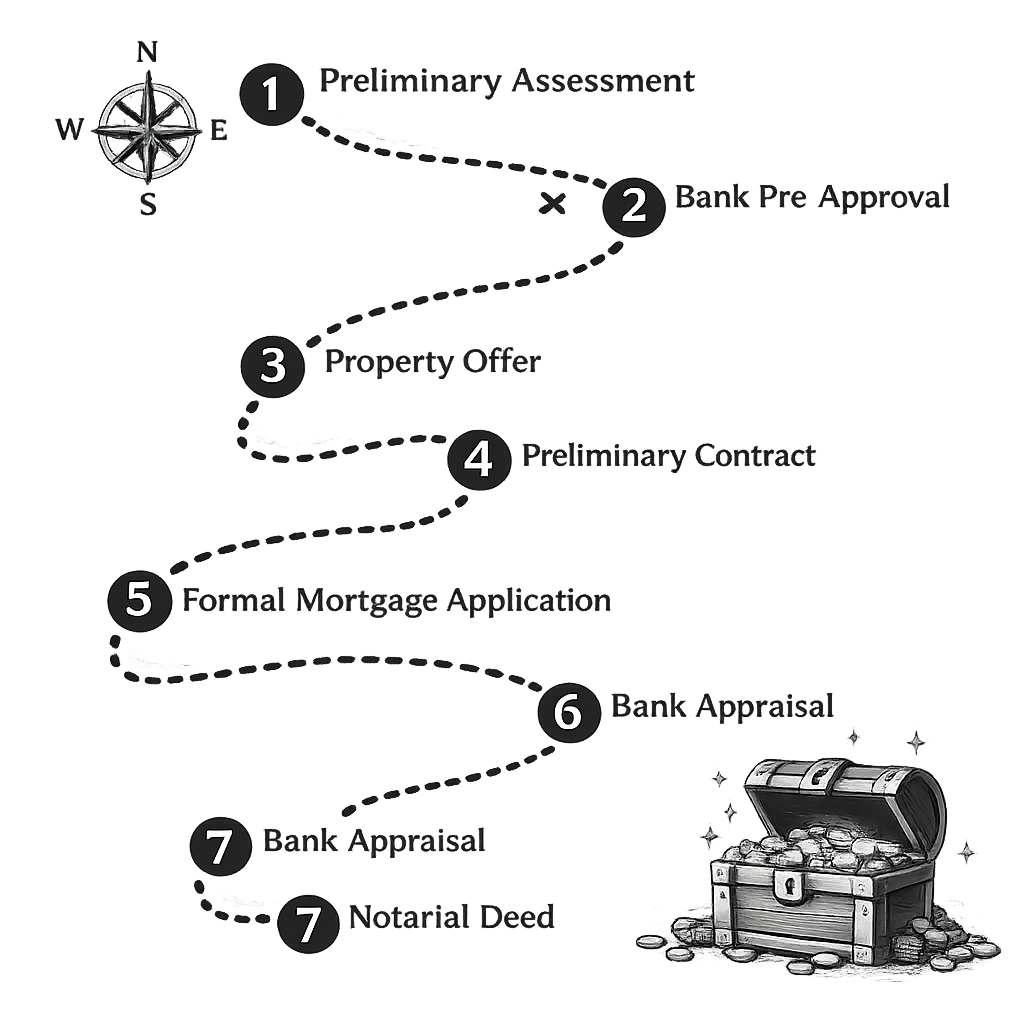
The Step-by-Step Mortgage Process
| Step | What Happens | Timeline |
| 1. Preliminary assessment | Talk to a mortgage broker. Understand your real budget. | Before property search |
| 1a. Bank pre-approval | You are sure a bank is with you if you respect the budget | While you search |
| 2. Property offer (Proposta d’acquisto) | Written offer submitted. Verbal offers have NO legal weight in Italy. Insert the mortgage suspensive clause | When property found |
| 3. Preliminary contract (Compromesso) | Sometimes is done after proposal, but the proposal is already a binding contract | |
| 4. Formal mortgage application | Full application submitted with income docs and property details. | Post-proposta |
| 5. Bank appraisal (Perizia) | Bank sends their own appraiser to value the property. | 1–2 weeks |
| 6. Mortgage approval | Bank issues formal offer. Review carefully. | After perizia |
| 7. Notarial deed (Rogito) | Final signing at the notaio. Keys handed over. Transaction complete. | Closing day |
| ⚠️ IMPORTANT | The notaio (Italian notary) represents the State — not you. They verify the transaction is legal and collect taxes. They are NOT your lawyer. Do your own due diligence before this stage, not at it. |
Total timeline from offer to closing: typically 2 to 3 months. Sometimes longer if there are compliance issues with the property. Plan accordingly.
What the Bank Also Checks — The Property
Italian real estate has a concept called conformità urbanistica — planning compliance. This concept is different from most English-speaking countries. In the US or UK, there’s usually a clear record of all the building permits, extensions, and modifications. In Italy, this record exists but is often incomplete or inaccurate.
Irregularities — called abusi edilizi (unauthorized building works) — are extremely common. A big percentage of Italian properties, especially in rural areas, have some form. An extension built without a permit in the 1980s. A room categorized differently in the catasto (the Italian land registry) than it is in real life.
| 🚨 COMMON MISTAKE | Not checking compliance before making an offer. If the bank’s appraiser spots an irregularity, they can reduce the appraised value — or refuse the mortgage entirely. I’ve seen deals collapse at the last minute because of a minor attic room categorized wrong 40 years ago. |
The fix: hire a geometra — that’s a licensed surveyor, similar to a chartered surveyor in the UK but with urban planning expertise — to review all the building permits and verify that the property on the ground matches the official records. Do this BEFORE signing the compromesso.
Don’t assume Italian banks are slow and unhelpful for foreigners. A few have built specific international buyer programs. The problem is they don’t advertise them. Most buyers walk into whatever branch is nearest the property — and that branch has zero experience with foreign applications. Going through a broker who works with banks that have international expertise can make the difference between getting approved or getting rejected.
Duration of the mortgage
In Italy, standard mortgages can last up to 30 or even 35 years. However, for international buyers, banks usually limit the duration to around 20 to 25 years.
There is also an important age-related rule. Italian banks typically allow a mortgage to run until a maximum age of 75, and in exceptional cases up to 80.
This means that if you are already in your late 50s or 60s, you need to carefully consider the loan duration. Even if you have a stable pension income, the bank may only approve a shorter mortgage term — sometimes 10 or at most 15 years.
When the loan term is shorter, the monthly payment increases. A higher monthly payment affects your debt-to-income ratio and reduces the total amount you can borrow.
In practical terms, this means that older buyers often qualify for smaller mortgages compared to younger applicants, simply because they have fewer years available to repay the loan.
The Two Banks We Work With
Alright. I promised to tell you this, so here it is.
Mediobanca
Credit Agricole
| 📝 NOTE | Which bank is right for you depends on your specific income profile, the property, and the loan amount. This isn’t a blanket recommendation. It’s a starting point. What matters is working with a broker who can match your application to the right institution. |
It’s not just about getting better terms.
Banks in Italy operate under very different internal guidelines and risk limits. Each institution has its own criteria regarding income assessment, loan-to-value ratios, acceptable countries of residence, age limits, and credit exposure.
As a result, applying to one bank instead of another can make the difference between being approved or being rejected.
WHAT TO DO BASED ON YOUR PROFILE
If You’re Retiring to Italy
Good news. Pension income is generally well-received by Italian banks. Your main challenge is the LTV limit and your age. Think about whether your savings can cover 40–50% of your target price plus fees. If the numbers work, get pre-approved early and find a property you know you can finance.
It’s important to discuss the loan term with both your broker and the bank, because in your specific case it could be the main limiting factor that reduces your borrowing capacity.
The duration of the mortgage directly impacts your monthly payment. If the term is shorter, the monthly installment increases, and that can significantly reduce the total amount you are eligible to borrow.
If You’re Buying a Vacation Home
Same LTV limits apply. Consider: is the property potentially rentable as a holiday let? Rental income won’t dramatically increase your mortgage capacity (banks discount it heavily), but it will offset your ownership costs. That changes the financial logic significantly.
If You’re an Investor
Think about leverage carefully. A 50% LTV mortgage on an Italian rental property can work if rental yields cover the mortgage payment. You should always compare the interest rate on your mortgage with the rental yield of the property.
If the rental yield is higher than the interest rate, that’s positive — it means your investment is generating income. If the rental yield is lower than the interest rate, you are effectively losing money on a cash-flow basis.
This doesn’t necessarily mean it’s a bad deal. There are many valid reasons to buy property in Italy beyond pure profit, such as lifestyle, long-term value, or personal use. But you need to be aware of the financial trade-off.
Another key factor to consider is whether your rental income covers both the mortgage payment and all property-related expenses. If the rent does not cover these costs, you will need to subsidize the property with your own money every month.
We can help you
If you want to start the process the right way we provide a buyer agent service, basically we work in your interests, that includes:
- Bureaucratic assistance (fiscal code, banks…)
- Property search
- Dealing
- Contractc (proposal and preliminary contract)
- Business planning, investmentent forecasts
- Due diligence
- Internal technical departmente
We also collaborate with many mortgage brokers specialized in international buyer that can give, to our clients a free first consultation and complete support to get a loan in Italy.
Send a message in the chat below